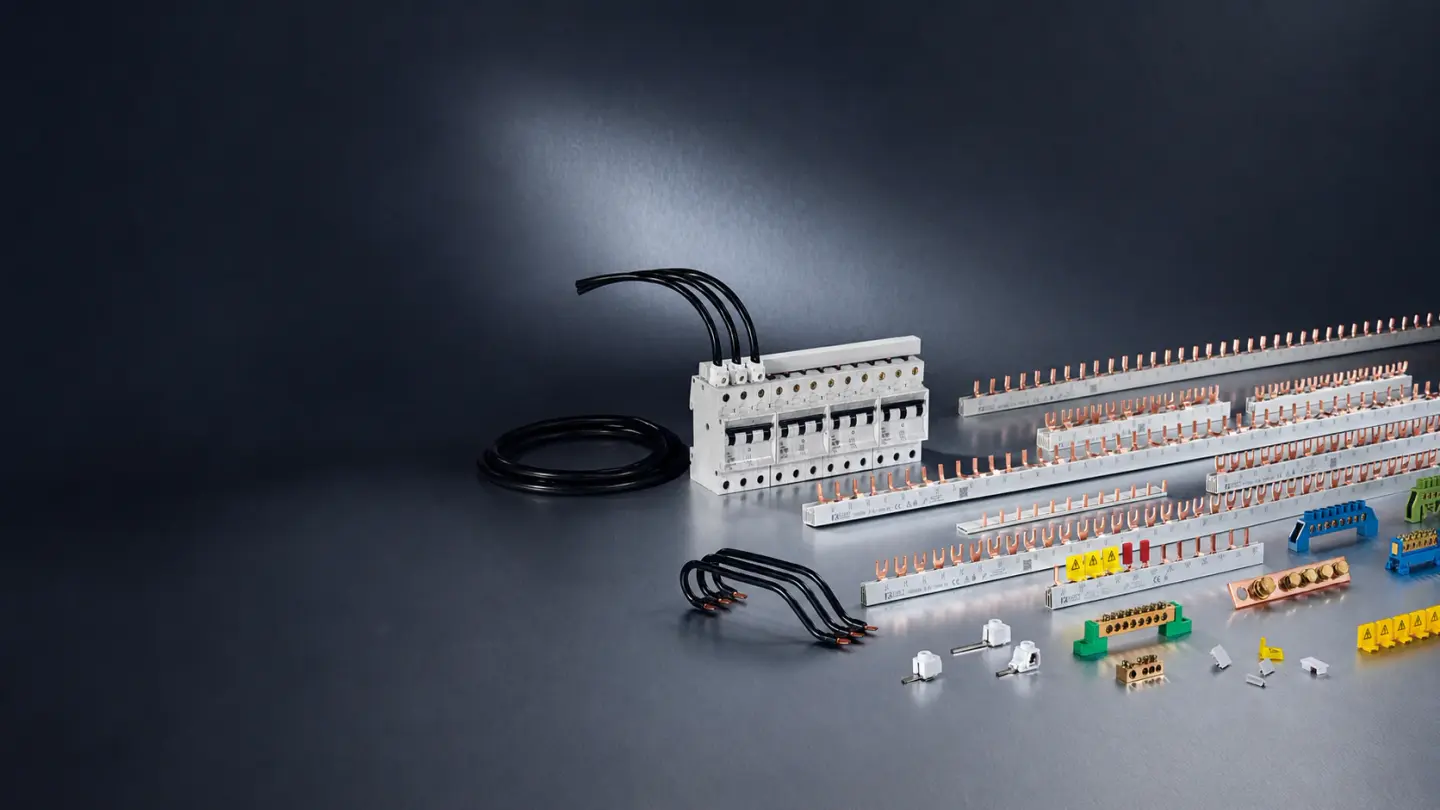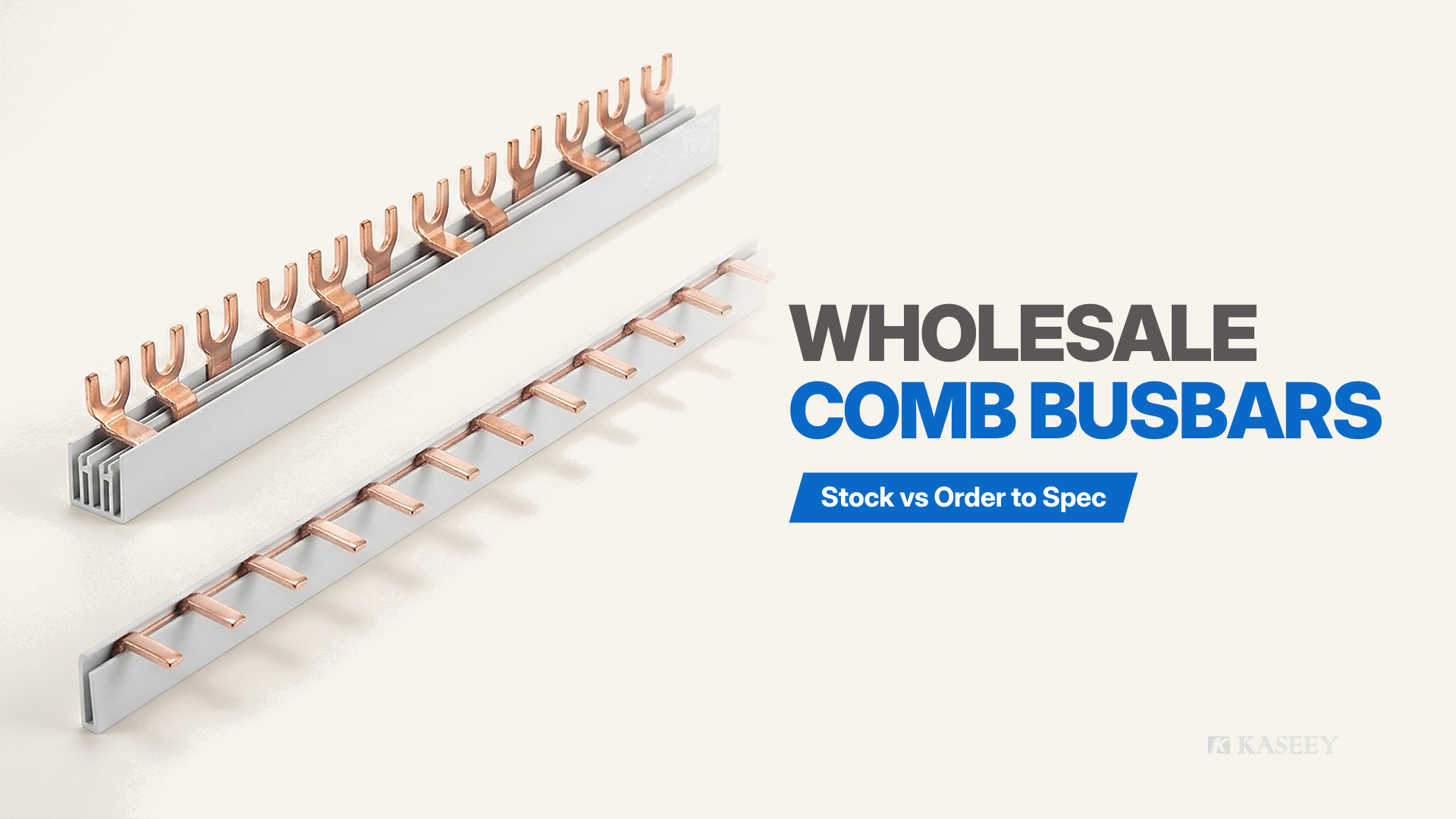
The first cut in any wholesale comb busbar order is splitting the catalog into two layers: frozen-specification standard families belong in warehouse stock, while narrow-specification references and drawing-led profiles must always be ordered to specification. Getting that boundary wrong either locks working capital into slow-moving, single-application bars or leaves panel-building customers waiting on everyday modular lengths that should have been on the shelf.
Once a distributor or OEM buyer has chosen a qualified manufacturer, purchasing performance depends on how cleanly the product line is partitioned. This guide maps KASEEY’s published product-line structure across standard pin and fork families, extended and fixed-specification references, and drawing-led custom comb busbars—without relying on assumed sales velocity or unverified market forecasts.
Why the Wholesale Comb Busbar Range Splits Into Two Layers
A wholesale comb busbar catalog splits into two operational layers because product families differ fundamentally in specification completeness rather than sales statistics. Standard families publish complete parameter matrices covering cross-section steps, standard lengths, and module counts, whereas drawing-led custom pages publish no specification table and require device-model and drawing confirmation before production.
Treating every SKU on a factory catalog as equally stockable creates immediate inventory distortion. In KASEEY’s comb busbar catalog, product families separate cleanly along an engineering-information boundary:
- Frozen-specification standard lines: Every part number carries a complete combination of terminal type, phase configuration, cross-section, reference current, length, and module count. The model code itself is the complete ordering reference.
- Order-to-specification and drawing-led lines: This layer splits into two sub-groups: extended-rating or single-specification families with narrow application windows, and customized references with no universal parameter table because tooth geometry and insulation profile depend on the customer’s switching device and drawing.
This structural division is derived strictly from how specifications are frozen and published across the product line, not from historical sales volume or regional demand claims. When a wholesale comb busbar buyer respects that line, shelf space is reserved for repeatable, multi-panel geometry while specialized bars flow through controlled project orders.
| Catalog Layer | Specification Completeness | Ordering Trigger | Inventory Role |
|---|---|---|---|
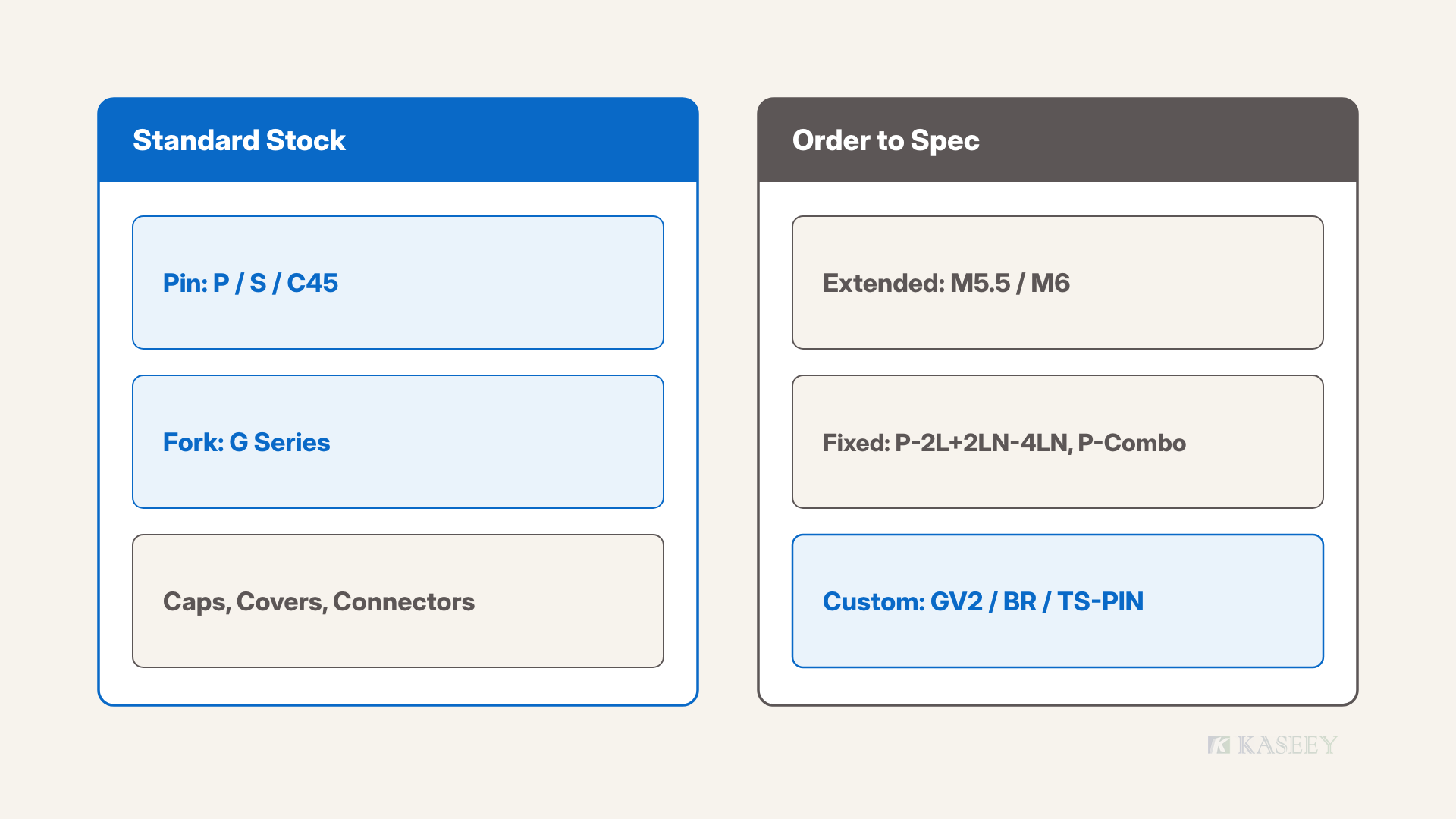
| Standard Pin and Fork Families (P, S, C45, G series) | Full parameter matrix published per SKU (cross-section, length, modules) | Model number alone | Core warehouse stock |
| Extended Rating Tier (M5.5 pin, M6 fork) | Published parameter table at extended cross-section | Confirmed project current and terminal fit | Order to specification |
| Fixed-Specification References (P-2L+2LN-4LN, 2-phase combination P-series) | Single fixed cross-section and current published | Exact panel layout match | Order to specification |
| Drawing-Led Customs (GV2, BR, TS-PIN) | No published specification table on product page | Device model plus customer drawing | Never stocked |
Decision rule: Stock a comb busbar family in your warehouse only when its cross-section, length, and module count are published as a complete, repeatable matrix; route extended, single-specification, and drawing-led items to order-to-specification purchasing.
The Stocking Core: Standard Pin and Fork Families
Standard pin-type (P, S, and C45 series) and fork-type (G series) comb busbars form the wholesale stocking core because every model publishes a complete, frozen specification matrix across 1P to 4P and 3L+3N configurations. Cross-sections of 8, 10, 13, and 16 mm2 pair with 50, 63, 70, and 80 A ratings across 210, 1000, and 1016 mm lengths.
For a wholesale comb busbar distributor, the practical advantage of the standard tier is predictability. Within the KASEEY comb busbar range, pin-type families (such as P-1L through P-4L, S-1L through S-4L, and C45 series) and fork-type families (such as G-1L through G-4L) are documented with fixed module counts paired to standard bar lengths. A buyer does not need a custom engineering review to reorder a standard 1000 mm or 1016 mm bar or a compact 210 mm segment, because the tooth pitch, phase sequence, and insulation profile remain constant from batch to batch.
| Product Tier | Representative Series | Pole & Phase Configurations | Cross-Section Steps | Reference Current | Standard Lengths |
|---|---|---|---|---|---|
| Standard Pin Type | P, S, C45 series | 1P, 2P, 3P, 4P, 3L+3N | 8, 10, 13, 16 mm2 | 50, 63, 70, 80 A | 210, 1000, 1016 mm |
| Standard Fork Type | G series | 1P, 2P, 3P, 4P | 8, 10, 13, 16 mm2 | 50, 63, 70, 80 A | 210, 1000, 1016 mm |
Decision rule: Build initial wholesale comb busbar stock depth around the 1P to 4P and 3L+3N standard pin and fork families where model codes map one-to-one to published cross-section, current, and length tables.
Even when ordering frozen-specification standard bars, one administrative error frequently disrupts wholesale replenishment: specifying either module count or millimeter length in isolation. Two bars can share a nominal 1000 mm or 1016 mm envelope while carrying different usable module counts depending on pole sequence and end overhang. Always record both the exact module count and the millimeter length together on every stock replenishment line, following the pairing discipline detailed in KASEEY’s guide to comb busbar length and module count.
Order to Specification: Extended and Fixed-Specification References
Extended-rating and fixed-specification comb busbar references carry real, published parameters, yet they belong in order-to-specification purchasing rather than general warehouse stock because their technical envelope is narrower. Specifically, KASEEY’s M5.5 pin-type and M6 fork-type families extend up to 25 mm2 and 100 A, while fixed-specification references lock into single cross-section and current combinations.
Distributors often make the mistake of treating a published specification table as an automatic green light to hold inventory. In reality, two distinct groups inside the published catalog sit outside the standard stocking core:
- Extended-rating families (M5.5 pin and M6 fork): Within KASEEY’s lineup, the 25 mm2 cross-section and 100 A reference rating belong specifically to the M5.5 pin-type and M6 fork-type product families—not to the general P, S, C45, or G standard range. Because 100 A distribution rows require heavier conductor geometry and matching breaker terminal capacity, demand is tied to specific higher-load panel builds rather than broad day-to-day modular replacement.
- Fixed-specification references: Certain specialized phase-and-neutral combinations are published at a single, non-stepped electrical rating. KASEEY’s pin-type 1P+N busbar family P-2L+2LN-4LN is published solely at 10 mm2 and 63 A. Similarly, KASEEY’s pin-type 2-phase combination P-series is published solely at 16 mm2 and 80 A. Unlike the stepped standard families that span four cross-sections, these fixed-specification references serve narrow panel architectures where an exact phase-neutral tooth layout is required.
| Reference Group | Specific KASEEY Family | Published Cross-Section | Published Reference Current | Why Ordered to Specification |
|---|---|---|---|---|
| Extended Pin Family | M5.5 pin type | Up to 25 mm2 | Up to 100 A | Higher-capacity rating isolated to M5.5 terminal geometry |
| Extended Fork Family | M6 fork type | Up to 25 mm2 | Up to 100 A | Higher-capacity rating isolated to M6 fork geometry |
| Fixed-Spec 1P+N Reference | P-2L+2LN-4LN | 10 mm2 only | 63 A only | Single fixed rating for specific 1P+N row layouts |
| Fixed-Spec 2-Phase Reference | 2-phase combination P-series | 16 mm2 only | 80 A only | Single fixed rating for specific 2-phase combination rows |
Decision rule: Keep M5.5 pin, M6 fork, P-2L+2LN-4LN, and 2-phase combination P-series comb busbars on order-to-specification status unless a recurring customer project locks in steady, verified consumption for that exact SKU.
Separating these items from the standard stocking core protects wholesale buyers from two opposite errors: over-investing in single-rating specialty bars that sit idle between projects, and misquoting the 100 A extended rating of M5.5 and M6 families as if it applied across the entire standard comb busbar catalog.
Never Stocked: Drawing-Led Custom Comb Busbars
Drawing-led custom comb busbars—including KASEEY’s GV2, BR, and TS-PIN customized references—are never stocked in a wholesale warehouse because no universal specification table exists to define them. Their product pages explicitly omit standard cross-section and length matrices, directing buyers to confirm production strictly through target device model numbers and engineering drawings.
Unlike standard pin and fork bars built around uniform DIN-rail spacing, customized references adapt to non-standard device pitches, motor-starter terminal offsets, or dedicated OEM layouts. On KASEEY’s customized GV2, BR, and TS-PIN pages, ordering relies on engineering confirmation rather than catalog selection: the buyer supplies the device model and drawing, the factory confirms geometry and parameters, and sample verification precedes production.
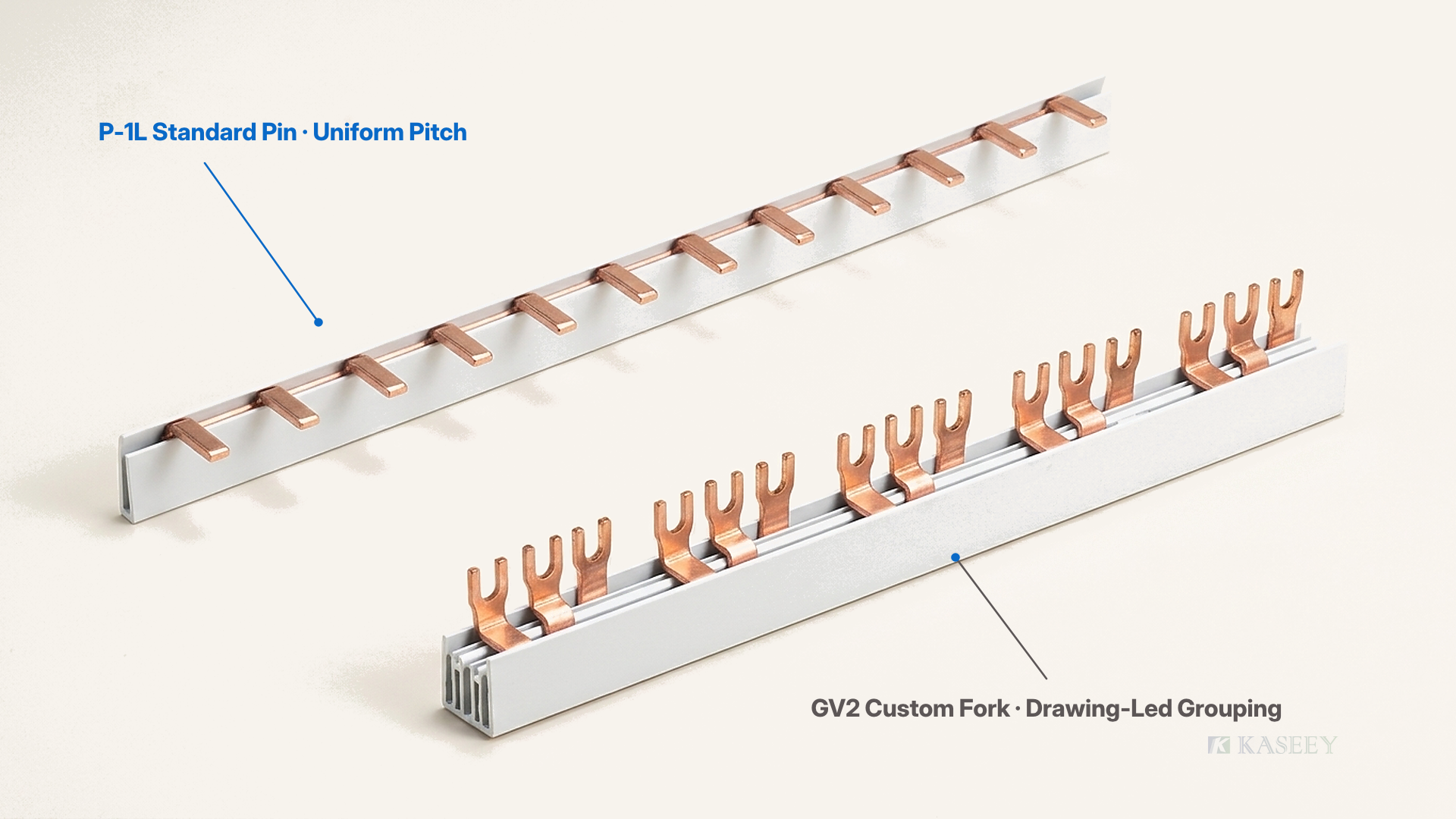
Because every variable—phase grouping, gap width between poles, pin or fork projection, and overall bar length—can shift from one equipment platform to another, holding speculative inventory on drawing-led references is commercially unviable. When a wholesale customer requests a GV2, BR, or TS-PIN style bar, the distributor acts as a project coordinator rather than a shelf supplier, following the intake and sample-approval sequence outlined in KASEEY’s custom comb busbar quote guide.
Stocking Accessories Alongside the Comb Busbar
Comb busbar end caps, protective covers, and feed-in connectors are ordered and stocked alongside the main bar because panel assemblers require them to finish cut ends, shield spare ways, and land incoming cables safely. Without matching accessories on the same wholesale shelf, a standard comb busbar shipment leaves the installer unable to complete touch-safe panel assembly.
Each accessory category serves a distinct mechanical and electrical completion role on the DIN rail:
- Busbar end caps: Every time a standard 1000 mm or 1016 mm comb busbar is cut to fit a shorter breaker row, exposed copper ends must be sealed to maintain insulation clearance—pair stock profiles directly using KASEEY’s guide on how to select busbar end caps.
- Busbar protective covers: Snap-on insulating tooth covers shield unused pins or forks on partially populated distribution rows against accidental contact during commissioning and maintenance.
- Feed-in connectors: Dedicated feed-in terminal connectors provide a rated mechanical clamping interface for incoming main supply conductors where a breaker terminal alone cannot accept both the busbar tooth and a large-gauge feeder cable.
Holding these three accessory lines in proportion to your standard pin and fork comb busbar inventory turns individual bar orders into complete, ready-to-install panel kits without adding specification complexity.
Wholesale Practicalities: Branding, Documentation, and Inquiry Scope
Once a wholesale comb busbar order is segmented into standard stock, order-to-specification references, and drawing-led customs, three commercial workstreams govern execution: private-label packaging, per-model compliance documentation, and inquiry preparation. Each follows a dedicated verification path rather than a blanket catalog assumption.
- Private labeling and OEM packaging: Distributors building house-brand busbar lines can review marking, sleeve printing, and carton packaging options through KASEEY’s OEM and ODM manufacturing page.
- Compliance and specification documents: Because test reports and conformity declarations apply to specific models and constructions rather than entire product categories indiscriminately, request documentation per SKU as explained in KASEEY’s guide to MCB busbar CE and UL documentation.
- Quoting non-standard and mixed orders: When an order includes extended-rating, fixed-specification, or drawing-led custom items, prepare the target device model, engineering drawing, phase sequence, cross-section, and destination market before requesting a factory quotation.
Frequently Asked Questions
What is the minimum order quantity for wholesale comb busbars?
There is no single minimum order quantity applied across the entire comb busbar catalog. Order quantities are confirmed per product family and order structure—separating frozen-specification standard pin and fork lines from order-to-specification or drawing-led custom builds—when submitting your item list for factory quotation.
Which comb busbars should a distributor stock first?
A distributor should build initial warehouse stock around KASEEY’s standard pin-type (P, S, and C45 series) and fork-type (G series) families across 1P to 4P and 3L+3N configurations. These families publish complete, frozen parameter tables across 8 to 16 mm2 (50 to 80 A) and standard 210, 1000, and 1016 mm lengths, allowing straightforward replenishment by model number.
Can standard and custom busbars be combined in one wholesale order?
Yes, standard stocking items and custom comb busbars can be discussed within the same wholesale procurement plan, but they follow separate confirmation tracks. Standard pin and fork bars are ordered directly by published SKU, while drawing-led custom references require device-model verification, engineering drawing sign-off, and sample approval before production.
Do wholesale orders support private labelling?
Yes, private labelling, custom part-number marking, and tailored packaging are supported for wholesale and OEM comb busbar programs depending on the selected product line and branding requirements. Review available marking and packaging capabilities directly with KASEEY’s manufacturing team during inquiry setup.
What documents come with a wholesale order?
Wholesale shipments are supported with specification sheets and compliance documentation matched to the exact ordered model numbers rather than generic category-wide claims. Buyers should specify destination-market requirements—such as European CE declarations or North American UL standards scope—per SKU at the inquiry stage so the correct per-model documents are prepared.
Planning Your Wholesale Comb Busbar Order
To structure a balanced wholesale comb busbar replenishment or OEM stock program directly with the manufacturer, prepare your itemized list by tier: standard pin and fork SKUs (specifying series, pole configuration, cross-section, length, and module count), any extended M5.5/M6 or fixed-specification references, and target device models plus drawings for custom bars. Reach out to KASEEY or email [email protected] with your itemized schedule and destination market to confirm per-family availability and documentation.
Sources
- Comb Busbars for MCBs | Pin & Fork Types | KASEEY — KASEEY; product category hub defining standard pin, fork, closed, and customized comb busbar families.
- Pin Type 1-Phase Busbars P-1L | KASEEY — KASEEY; first-party product specification table documenting 8/10/13/16 mm2 cross-sections, 50/63/70/80 A ratings, and 210/1000/1016 mm standard lengths.
- Fork Type 1-Phase Busbars M6 | KASEEY — KASEEY; first-party product specification documenting the extended M6 fork-type family up to 25 mm2 and 100 A.
- Customized busbars GV2 | KASEEY — KASEEY; first-party customized busbar reference demonstrating drawing-led ordering with no published standard specification table and confirmation by device model and drawing.