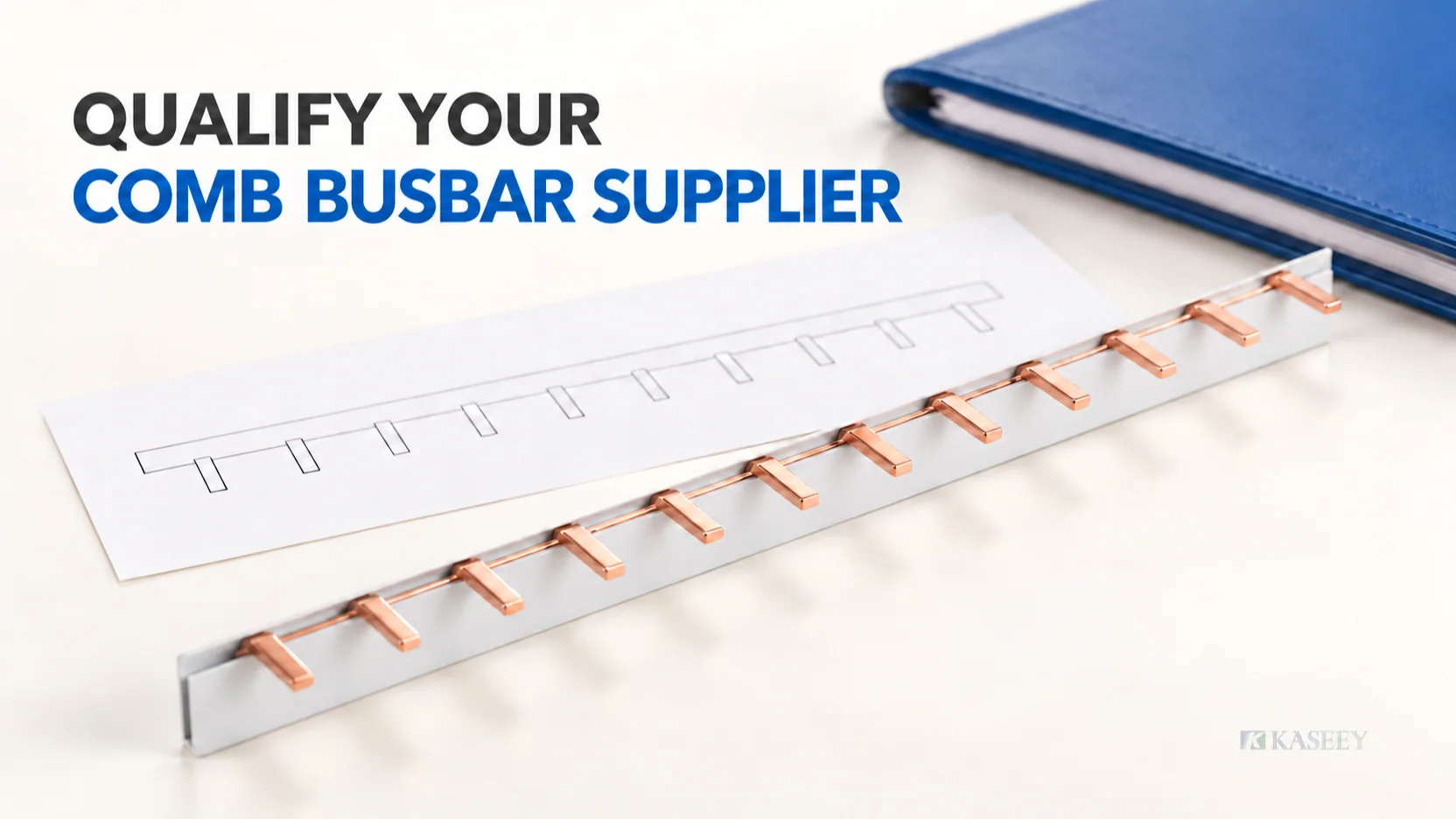
To qualify a comb busbar supplier for OEM supply, define the exact busbar and device configuration, verify the relevant production controls and product documents, approve representative samples, and confirm a pilot lot against written acceptance criteria. Before releasing repeat orders, agree traceability, change notification, delivery assumptions and responsibility for nonconforming supply.
The qualification decision should identify which supplier, production site, busbar revision and application are approved. A good sample or an attractive quotation does not establish that the same configuration will reach your production line on every reorder.
This guide provides a proposed buyer qualification workflow for engineering, supplier-quality and purchasing teams. Use it to build an approval record for your own program; the actual limits, evidence and release authority must be agreed for that program.
Define the scope of supplier approval
Separate three questions at the start:
- Who will supply the part? Identify the contracting company, manufacturing site, relevant subcontractors and technical contact.
- What configuration will be approved? Record the full order code, drawing revision, materials, accessories and any customization.
- Where will it be used? Identify the exact modular-device series, complete row arrangement, panel application and destination market.
An approval for one pin-type configuration does not automatically cover a fork-type alternative, a different neutral arrangement or another production site. Write the intended approval scope before comparing suppliers so quotations and samples answer the same requirement.
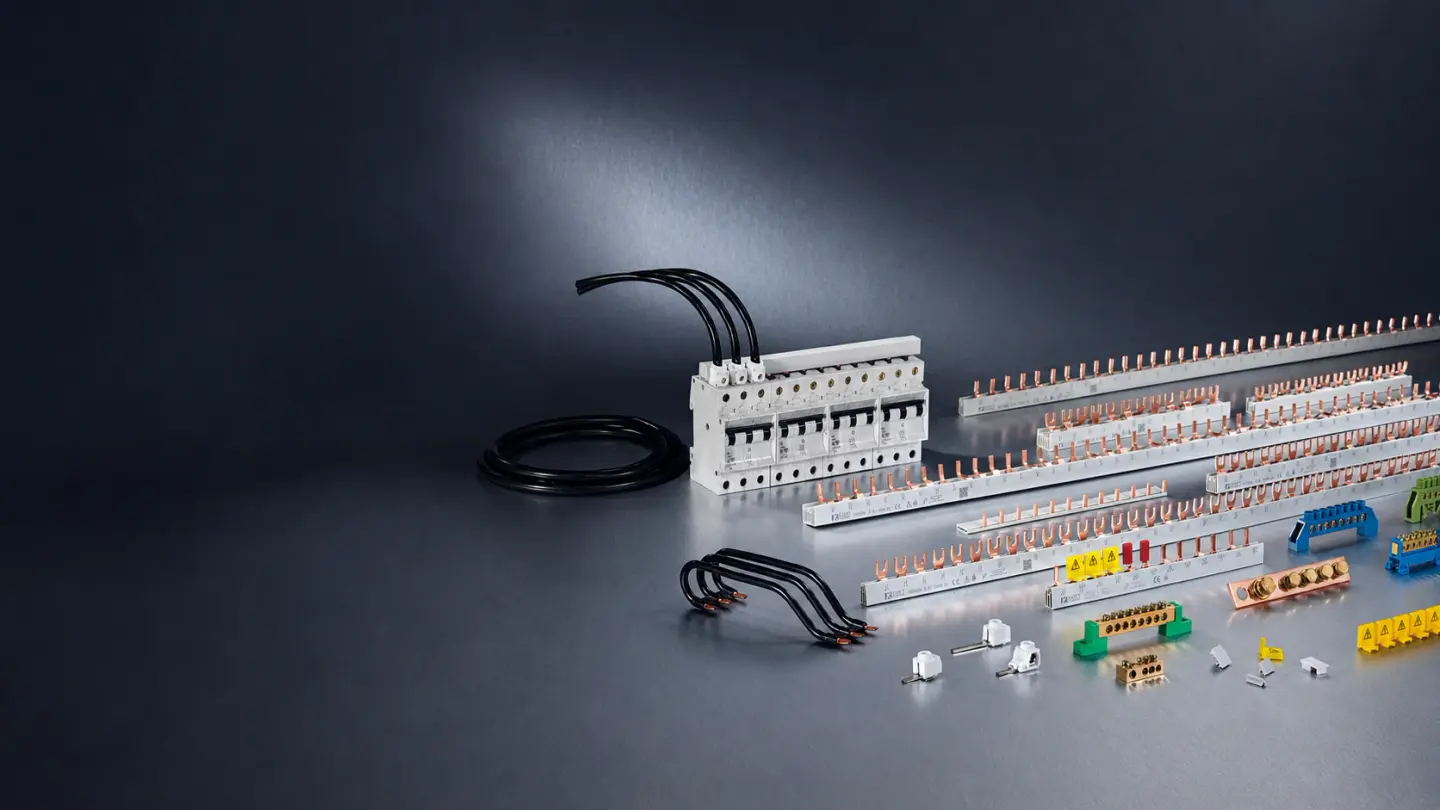
The KASEEY comb busbar range includes pin, fork and custom configurations. Start with the contact form accepted by the intended device, then confirm the exact variant. If the component specification is still open, resolve it using the MCB busbar selection guide before treating a supplier sample as the approval baseline.
Freeze a comb-specific technical baseline
Give prospective suppliers a controlled requirement rather than a description such as “a standard comb busbar for our breakers.” Include the following fields in the drawing, specification or referenced approval documents.
| Baseline field | What to define for qualification |
|---|---|
| Contact interface | Pin or fork form; exposed-contact width, thickness, length and orientation; fork opening where applicable. |
| Complete contact pattern | Tooth count, pitch, overall pattern and intended positions across the entire device row. |
| Device and pole arrangement | Exact device references, widths, phase/neutral sequence, auxiliaries and any intentional gaps. |
| Conductor and finish | Agreed material specification, cross-section, finish and supporting identification or evidence requirements. |
| Insulation and accessories | Agreed insulation specification and coverage, length, end caps, protective covers and feed accessories. |
| Electrical application | Required ratings and documented conditions, feed arrangement, intended loading and application boundaries. |
| Dimensional acceptance | Drawing revision, datums, tolerances and agreed measurement methods for the relevant features. |
| Order identity | Full order code and variant, approved deviations, marking reference and packaging reference. |
For a long comb, require an agreed way to evaluate the complete contact pattern. Checking one adjacent pitch alone does not establish alignment at the far end of a device row. Define which dimensions and positions matter, then ask how the supplier controls and measures them.
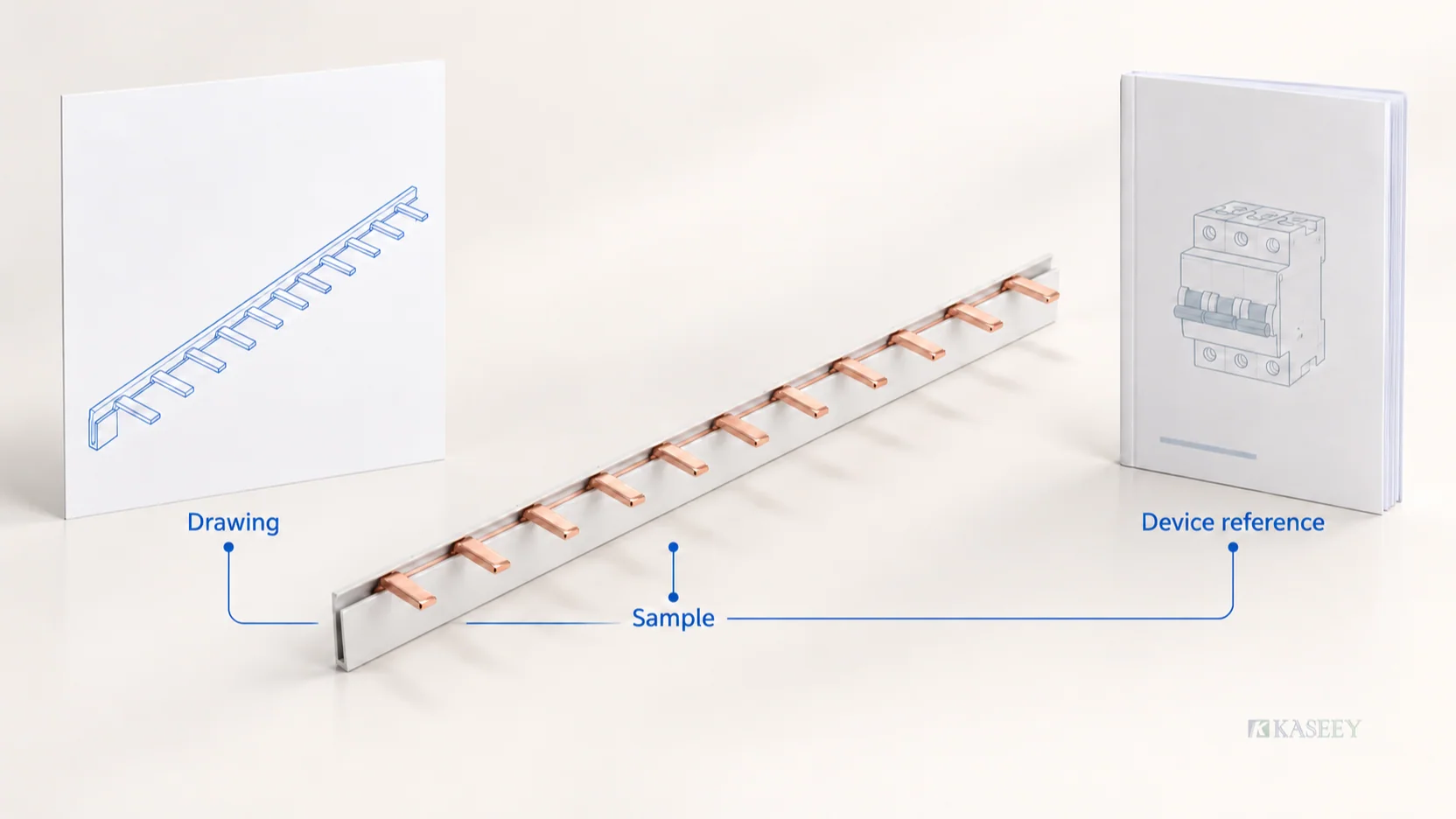
Keep the drawing, sample and device documentation consistent. A nominal catalogue dimension does not supply an unstated tolerance, and a familiar breaker size does not prove terminal fit. Any contradiction belongs in the review record before approval.
Ask the supplier to demonstrate the production-to-record chain
A factory photograph shows a setting. A qualification review needs evidence of how the approved specification reaches production and how the resulting parts remain identifiable.
Ask the supplier to explain who controls the relevant material preparation, contact forming or processing, insulation assembly, inspection and packing steps. Identify outsourced work where it affects the approved construction or acceptance criteria. For each relevant step, ask:
- How does the operator receive the current drawing and order variant?
- What prevents an obsolete revision or a similar-looking configuration from being used?
- Which product features are checked, by what method, and against which limits?
- How are suitable inspection tools identified and their calibration status controlled?
- How are nonconforming parts separated, investigated and released or rejected?
- How is a finished lot connected to the records agreed for the order?
Request a relevant redacted example, an agreed remote review or an on-site audit when the program warrants it. Distinguish a blank procedure from a completed record: the first describes intended control; the second shows how a particular order was handled.
One useful traceability exercise is to select an identified finished sample or package and ask the supplier to retrieve its order reference, drawing revision and agreed production or inspection records. Check whether the identifiers reconcile. Do not demand an unrelated document stack that cannot be connected to the part being reviewed.
KASEEY’s quality-control guidance describes checks and release evidence around the confirmed model and order scope. Ask which records can be provided for your selected comb busbar and include the agreed evidence set in the qualification plan.
Match certificates and reports to the proposed part
Review company qualifications, product evidence and panel verification separately. They answer different questions.
| Evidence layer | What the buyer should establish |
|---|---|
| Management-system certificate | Correct legal entity and site, relevant scope, issuer, status and applicable edition or transition arrangements. |
| Component certificate or test report | Covered model and construction, ratings, test conditions, standard and edition, document identity and application restrictions. |
| Intended assembly assessment | Whether the selected component and its integration are addressed by the panel’s applicable verification route. |
ISO 9001 concerns a quality-management system. Its certification is not a substitute for conformity evidence for the busbar itself, as explained in the ISO/IAF guidance on accredited ISO 9001 certification.
For each product document, record the issuer, document number, covered model or family, revision, stated ratings and conditions. Check whether the proposed material, insulation, contact geometry, private-label identity or manufacturing change remains within its scope. Seek confirmation from the appropriate technical or certification party when applicability is uncertain.
For programs using the IEC 61439 series, IEC 61439-1:2020 addresses general requirements and verification for low-voltage switchgear and controlgear assemblies, together with the relevant assembly part. Accepting a loose comb busbar or its supplier does not by itself complete the finished assembly’s verification.
Use the KASEEY certification library as a starting point for the document request. Confirm the exact proposed model and destination market rather than assuming that a company certificate or a logo covers the whole catalogue.
Approve samples against written criteria
Before ordering samples, agree what they must demonstrate and whether they represent the intended production route. Record the sample identity, drawing revision and any differences from the planned production process. A specially prepared sample may be useful for design review, but its manufacturing differences need to remain visible in the approval decision.
The sample review should address:
- Identity and geometry: correct contact form, complete pattern, dimensions and agreed tolerances.
- Device interface: a documented review or controlled fit check with the exact intended device references, under the device manufacturer’s instructions.
- Materials and insulation: the agreed references and available supporting evidence, including accessory and end treatment where required.
- Electrical evidence: the applicable model or assembly validation scope, agreed methods and acceptance criteria.
- Records: actual findings, sample identification, deviations, reviewer and disposition.
Keep electrical validation under the responsible engineering or qualified test function. A dimensional fit check does not establish current-carrying performance, temperature rise or short-circuit suitability. Do not improvise acceptance limits from appearance or conductor cross-section alone.
Retain an identified reference sample where useful, supported by the released drawing and approval record. The reference should help resolve future questions; it should not replace controlled dimensions or written acceptance criteria.
Use a pilot lot to check repeatability
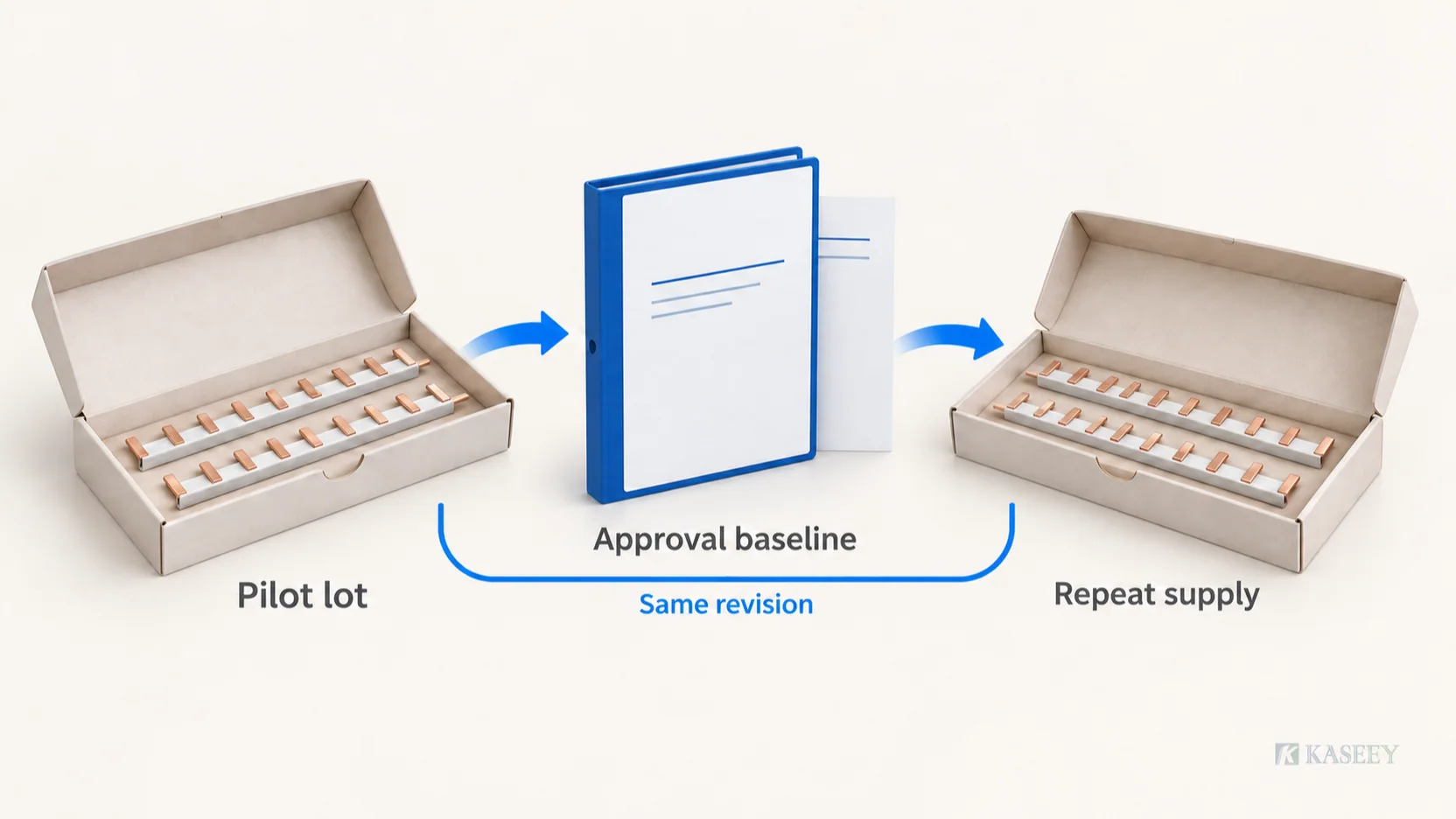
Move from a reviewed sample to an agreed pilot produced through the intended route. Define its quantity, process scope, inspection plan and release conditions before it is made. The relevant question is whether production can reproduce the approved configuration with records that remain connected to it.
| Pilot question | Evidence to review before volume release |
|---|---|
| Was the agreed route used? | Production site and process references, with differences or substitutions disclosed. |
| Does the complete contact pattern remain consistent? | Recorded results against the drawing, including the agreed positions across the pattern. |
| Are insulation, accessories and variant identity controlled? | Checks against the released specification and order reference. |
| Can the lot be traced? | Lot/package identification connected to the agreed production and release records. |
| Were deviations resolved? | Containment, disposition and any required corrective-action evidence. |
| Does shipment execution match the order? | Agreed packing, document set and dispatch readiness. |
Choose sampling and any separate complete checks through the approved quality plan. If the supply agreement uses an attribute acceptance-sampling scheme, ISO 2859-1 provides AQL-indexed plans for lot-by-lot inspection. Agree the applicable edition and plan; a lot-sampling result does not replace supplier qualification or the product’s technical validation.
Use the comb busbar incoming inspection checklist for the detailed receiving decision after shipment. During qualification, establish that the required measurements, identifiers and records can actually be produced and reconciled.
Turn delivery promises into an executable supply plan
Evaluate the schedule for the defined order variant and forecast. Ask the supplier to identify dependencies such as material availability, tooling or configuration changes, sample approval, production allocation, inspection documents and packing.
Separate these milestones in the agreement:
- Sample preparation and review.
- Closure of technical or document questions.
- Pilot production and approval.
- Repeat-order production, inspection and packing.
- Dispatch readiness and the agreed transport arrangements.
Record what starts each lead-time commitment and what happens if the buyer changes the drawing or delays approval. Dispatch readiness and arrival at your factory are different milestones. Compare quotations using the same quantity, configuration, document scope and delivery basis.
For an established supplier, request relevant historical delivery and corrective-action evidence where available. For a new configuration without a production history, use the pilot and an agreed ramp-up plan to establish what can be committed. A low unit price does not resolve an unverified technical or supply requirement.
Agree changes and nonconformance handling before reorders
Define changes that require notification and review. Depending on the approved scope, these can include conductor or insulation specification, finish, contact geometry, tooling or process route, production site, relevant subcontractor, accessories, markings or packing.
The agreement should identify who decides whether a change requires document review, new samples, testing or another pilot. Require the revised baseline and disposition to be recorded before affected supply is released. Do not leave a material or geometry substitution to an informal message after shipment.
Also agree how the parties handle a nonconforming delivery: affected-lot identification, containment, replacement or other disposition, root-cause review and evidence that the corrective action worked. Define the decision owners and escalation route without inventing a universal response deadline.
For private-label programs, connect the approved technical revision to the current marking and packaging reference. The OEM comb busbar branding approval workflow covers that artwork and physical-proof task in more detail.
Issue a scoped supplier qualification decision
Use the following record to close the review. Enter real references and findings; avoid a weighted score that allows price or presentation to cancel an unresolved technical requirement.
| Approval record | Required entry |
|---|---|
| Supplier identity | Contracting entity, production site, responsible contacts and relevant outsourced scope. |
| Approved configuration | Full order code, controlled drawing revision, specification and accepted deviations. |
| Application scope | Device references, row arrangement, panel program and destination market. |
| Technical evidence | Sample review, relevant document scope and validation references. |
| Production evidence | Pilot findings, traceability exercise and required release records. |
| Supply agreement | Forecast basis, schedule assumptions, packing/documents and escalation owner. |
| Ongoing controls | Change-notification agreement, nonconformance process and review triggers. |
| Decision | Authorized status, conditions, date and engineering/quality/purchasing sign-off. |
Approve for the recorded scope when the required evidence and agreements are complete. Limit approval to a defined pilot or conditional scope when the remaining work and boundaries are explicit. Hold approval when identity, compatibility, document applicability or a required acceptance result remains unresolved.
Revisit the decision when an agreed change trigger occurs or performance shows that the approved controls are no longer effective. A new model or construction deserves its own applicability review rather than being added to the approved list by resemblance.
Start an OEM comb busbar review with KASEEY
Bring KASEEY the device schedule, controlled drawing or sample reference, required configuration, destination market, quantity or forecast, document requirements and target milestones. Identify what is already approved and what still needs engineering review.
The published KASEEY OEM/ODM route connects requirement review, controlled definition, samples, pilot production and delivery. Use the custom busbar and OEM program to frame the project, then contact KASEEY to confirm the model-specific evidence and proposed approval route available for your requirement.
The useful outcome is a reviewable supplier approval package: one defined configuration, evidence that belongs to it, and clear responsibilities for keeping repeat supply aligned with that baseline.