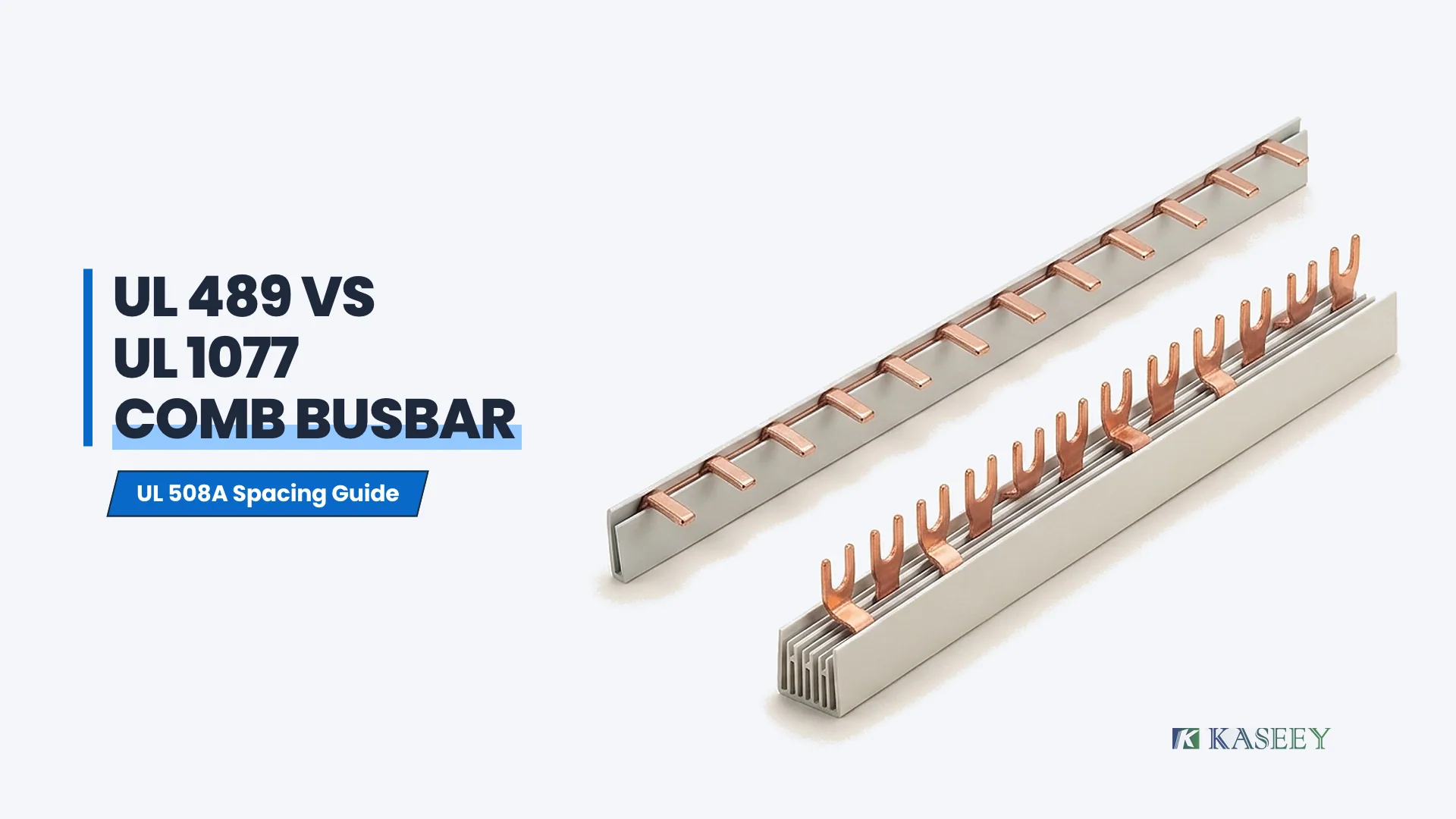
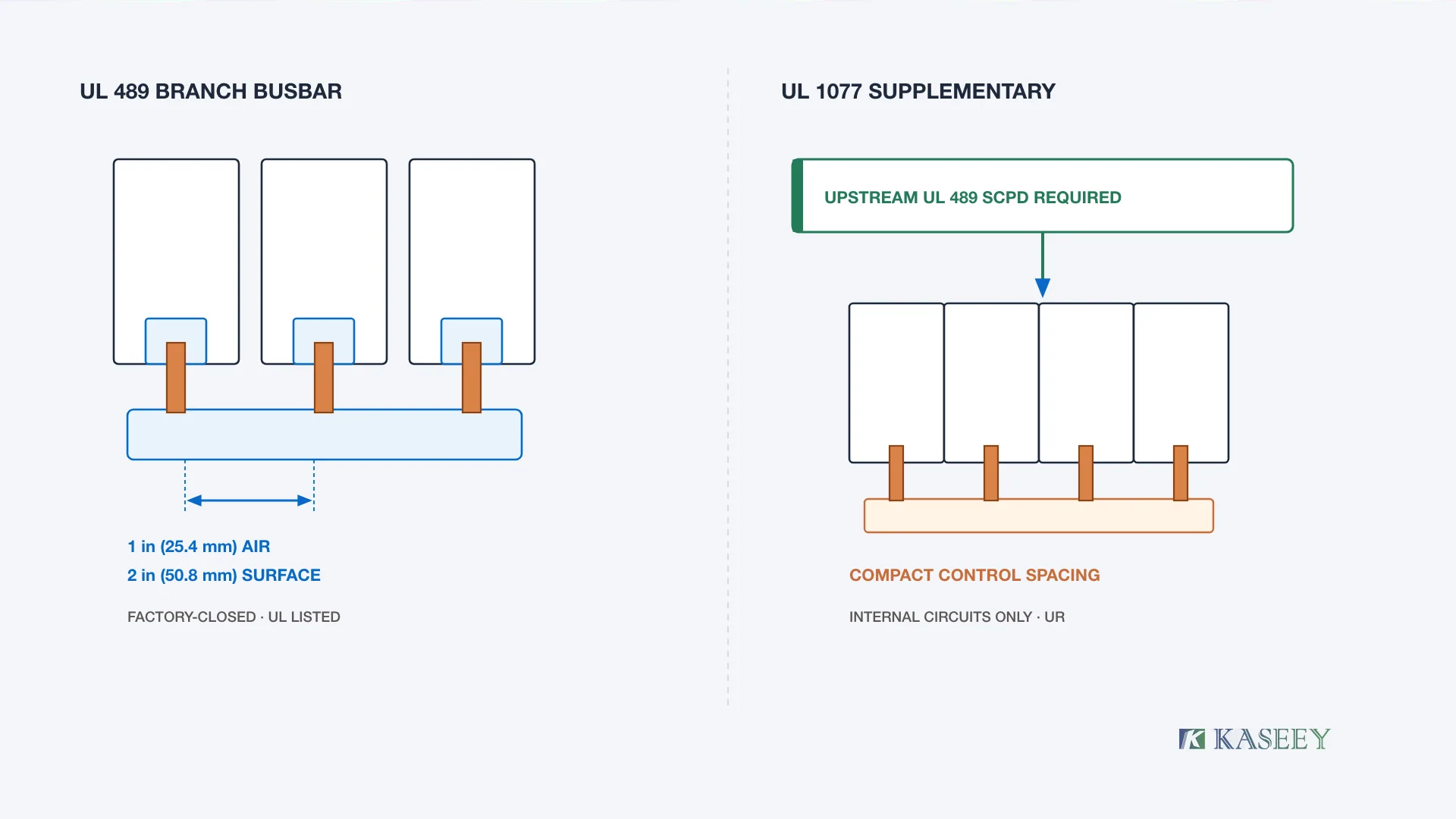
UL 489 branch-circuit comb busbars and UL 1077 supplementary-protector comb busbars are not physically or legally interchangeable inside North American UL 508A industrial control panels. UL 489 comb busbars enforce wider feeder clearance and creepage (up to 1 in / 25.4 mm through air and 2 in / 50.8 mm over surface) with deeper insulated shrouds, whereas UL 1077 comb busbars serve only compact downstream supplementary circuits behind an upstream UL 489 protective device.
This comparison applies to North American industrial control panels governed by UL 508A, UL 489, and UL 1077 alongside NFPA 70 (NEC) Section 110.3(B) listing instructions. For broader paperwork distinctions between European CE conformity declarations and North American UL file verification, refer to our MCB busbar CE and UL documentation guide.
Core Physical and Compliance Differences Between UL 489 and UL 1077 Comb Busbars
Comparing UL 489 and UL 1077 comb busbars starts at the circuit function rather than the DIN rail: UL 489 devices protect field-wiring branch circuits directly at feeder fault levels, while UL 1077 devices provide secondary component protection inside equipment already protected upstream. That regulatory boundary drives five concrete physical differences in busbar insulation, pitch, and terminal geometry.
| Comparison Axis | UL 489 Branch-Circuit Comb Busbar | UL 1077 Supplementary-Protector Comb Busbar | UL 508A Panel Impact |
|---|---|---|---|
| Circuit role & upstream requirement | Standalone branch-circuit distribution; no separate upstream branch breaker required | Downstream internal component protection only; mandatory upstream UL 489 branch SCPD | Using a UL 1077 bar on primary branch feeders fails UL 508A inspection immediately |
| Clearance & creepage (251–600 V feeder) | Designed for stricter feeder spacings (up to 1 in / 25.4 mm through air and 2 in / 50.8 mm over surface) | Compact control-circuit spacings evaluated under UL 1077 component recognition | Reduced creepage on a UL 1077 bar violates UL 508A feeder spacing tables |
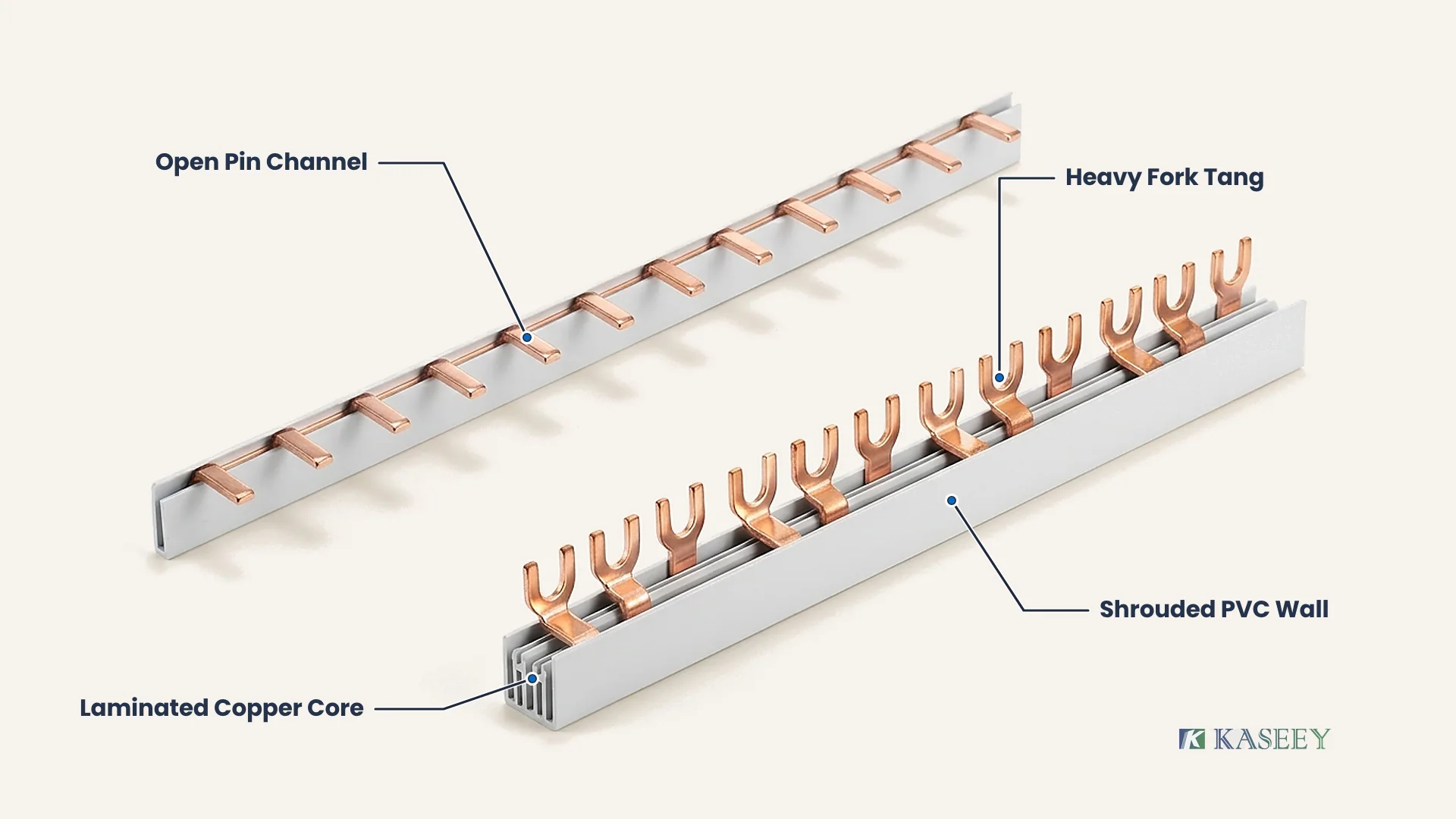
| Insulating shroud & tooth geometry | Taller, deeply shrouded insulating housing and dedicated UL 489 terminal pin/fork profile | Standard compact modular channel (similar to 17.8–18 mm IEC profiles) | Pin depth, shroud skirt, and terminal jaw alignment clash if cross-mounted |
| Typical ampacity & field cutting | Typically 80 A to 115 A factory-sealed fixed-length assemblies; field cutting generally prohibited | Typically 63 A to 100 A; many models allow field cutting with matched end caps | Cutting a closed UL 489 busbar destroys feeder creepage and voids UL Listing |
| Certification mark scope | UL Listed for specific UL 489 breaker families and documented SCCR (kA) | UL Component Recognized (UR) with Conditions of Acceptability for specific UL 1077 devices | Assembly SCCR collapses to 5 kA default if unlisted busbars feed branch circuits |
Specify a UL 489-listed comb busbar whenever distributing power to field-wiring branch circuits or motor/heater loads without an intermediate branch breaker; restrict UL 1077 comb busbars strictly to localized internal control power circuits downstream of a UL 489 feeder breaker.
How UL 508A Feeder Spacing Rules Restrict Comb Busbar Selection
Under UL 508A, live feeder busbars above 250 V up to 600 V require minimum electrical spacings of 1 in (25.4 mm) through air and 2 in (50.8 mm) over insulating surfaces unless listed as a complete feeder assembly. Compact comb busbars built solely for IEC or UL 1077 spacing cannot satisfy those feeder dimensions.
Three physical constraints explain why panel inspectors reject improper busbar substitutions during UL 508A shop audits:
- Exposed cut ends breach over-surface creepage: Trimming an open-ended comb busbar leaves copper ends only millimeters from adjacent phases or metal enclosure walls. Even with snap-on EK1-4 insulating end caps designed for IEC cuttable rows (covered in our comb busbar cutting guide), a UL 489 branch-circuit busbar must retain its factory-molded sealed end insulation unless its UL listing instructions explicitly permit field cutting with a listed end-cap kit.
- Incoming feeder lugs must maintain feeder spacing: Landing an incoming 6 AWG to 2 AWG main copper cable onto a UL 489 comb busbar requires a dedicated UL-listed feeder terminal block with matching phase barriers—never a bare crimp lug or unshrouded clamp jammed beside a copper tooth.
- SCCR coordination depends on verified device pairings: Unlike IEC 61439-1 Clause 10.11.2 conditional exemptions (analyzed in our IEC 61439 comb busbar short-circuit guide), UL 508A Supplement SB requires documented UL Listing or Recognition for the exact feeder busbar and branch-circuit breaker combination to maintain high panel SCCR.
Three UL 508A Inspection Failures Caused by Cross-Mounting UL 489 and UL 1077 Busbars
Attempting to install a UL 1077 comb busbar onto UL 489 branch-circuit breakers—or forcing an IEC-only comb bar into a North American UL 508A control panel—triggers immediate mechanical and regulatory failure. Because UL 489 breakers house larger arc chutes and deeper insulated terminal shrouds, cross-mounting creates three recurring shop-floor rejections.
| Cross-Mounting Error | Observable Mechanical or Electrical Defect | UL 508A / NEC Consequence | Compliant Corrective Action |
|---|---|---|---|
| UL 1077 comb busbar forced onto UL 489 breakers | Short copper pins seat only halfway inside deeper UL 489 cages; insulator skirt collides with breaker shroud | Violates NFPA 70 (NEC) 110.3(B) and UL 508A feeder spacing; creates overheating hot spots | Replace with a UL 489-listed comb busbar matched to the exact breaker series |
| UL 489 comb busbar installed on UL 1077 protectors | Over-length insulated pins bottom out early or leave unshrouded copper exposed above compact UL 1077 jaws | Exposed live copper reduces clearance and fails finger-safe inspection | Use a UL 1077-recognized comb busbar matching the supplementary protector terminal drawing |
| Field-cut IEC comb busbar used on a UL 508A branch row | Cut copper end sits < 2 in over surface from adjacent phase or DIN rail | UL inspector downgrades panel SCCR to 5 kA or withholds UL 508A panel label | Switch to a factory-closed UL-evaluated busbar or individually wired listed distribution block |
Reject any cross-standard substitution during incoming panel inspection; correcting a mismatched comb busbar before panel wiring takes minutes, whereas failing a UL 508A field evaluation forces complete row teardown.
Specifying Comb Busbars and Feeder Hardware for North American OEM Control Panels
Export machinery builders and North American control panel shops sourcing modular busbars should separate IEC catalog orders from UL 508A project requirements at the quotation stage. KASEEY manufactures standard open-channel pin and fork busbars, fork-type 3-phase closed busbars, and TB25/TB50 feed-in connectors across our comb busbars range, alongside drawing-led custom busbar OEM supply for panel builders matching exact breaker interfaces.
Before submitting an OEM busbar inquiry for a North American or dual-market control panel (see also our MCB busbar selection guide and custom comb busbar quote checklist), confirm five concrete inputs:
- Circuit classification: State explicitly whether the row is a UL 489 branch/feeder circuit or a UL 1077 downstream supplementary circuit.
- Mating breaker terminal drawing: Provide exact pole pitch, terminal throat depth, pin vs fork thickness, and shroud skirt clearance.
- Required certification & file scope: Specify whether your inspector requires UL Listing, UL Component Recognition (UR) with Conditions of Acceptability, or IEC-only documentation, and verify per-model file coverage before ordering.
- Incoming feeder conductor range (AWG) and feed point: Confirm end-feed vs center-feed current rating and matching insulated feeder lug capacity.
- Closed-end vs cuttable construction: Lock exact pole count and phase sequence (1P, 2P, 3P) when factory-closed ends are required to preserve feeder creepage.
If your engineering team is specifying standard or custom-profile comb busbars for multi-market control cabinets, share your mating device drawings, pole sequence, pitch, cross-section (mm²), destination market, and estimated volume via KASEEY Contact or [email protected] for a technical specification review.
Frequently Asked Questions
Can a UL 489 comb busbar be used on UL 1077 supplementary protectors?
No. Although UL 489 carries stricter feeder spacing and fault ratings than UL 1077, UL 489 comb busbars use taller insulated shrouds and longer terminal pins tailored to UL 489 breaker cages. Mounting a UL 489 comb bar onto compact UL 1077 protectors leaves copper teeth partially exposed or prevents full screw-clamp seating.
Can you field-cut a UL 489 comb busbar like a standard IEC cuttable comb bar?
In most UL 508A installations, no. UL 489 branch-circuit comb busbars are typically factory-sealed closed assemblies engineered to maintain 1 in through-air and 2 in over-surface feeder spacings. Field cutting breaches the molded end barrier and invalidates the UL Listing unless the manufacturer’s written listing instructions explicitly authorize cutting with a listed end-cap kit.
Does an IEC 61439 comb busbar qualify as UL 489 or UL 1077 in a UL 508A panel?
No. Compliance with IEC 61439 or European CE marking does not satisfy UL 489 branch-circuit listing or UL 1077 component recognition under UL 508A. Panels requiring a UL 508A label must use busbars carrying verified UL Listing or UR Recognition matched to the installed protective device family and stated SCCR.
Sources
- UL Standards & Engagement — UL 489, UL 1077, and UL 508A — UL Standards & Engagement; official standards discovery portal covering molded-case circuit breakers (UL 489), supplementary protectors (UL 1077), and industrial control panels feeder spacing and SCCR rules (UL 508A).
- NFPA 70: National Electrical Code (NEC) — Section 110.3(B) — National Fire Protection Association (NFPA); governing North American requirement to install listed and labeled electrical equipment strictly per listing instructions.
- Comb Busbars for MCBs | KASEEY — KASEEY; first-party product category hub for pin-type, fork-type, closed, and custom OEM comb busbars.
- Fork Type 3-Phase Closed Busbars | KASEEY — KASEEY; first-party product page for factory-closed insulated 3-phase comb busbars.
- Busbar Connector TB25 / TB50 | KASEEY — KASEEY; first-party product page for comb busbar feed-in connectors.
- Busbar End Caps EK1-4 | KASEEY — KASEEY; first-party product page for insulating comb busbar end caps.
- Custom Busbar OEM Solutions | KASEEY — KASEEY; first-party OEM/ODM capability page for drawing-led custom comb busbars.