
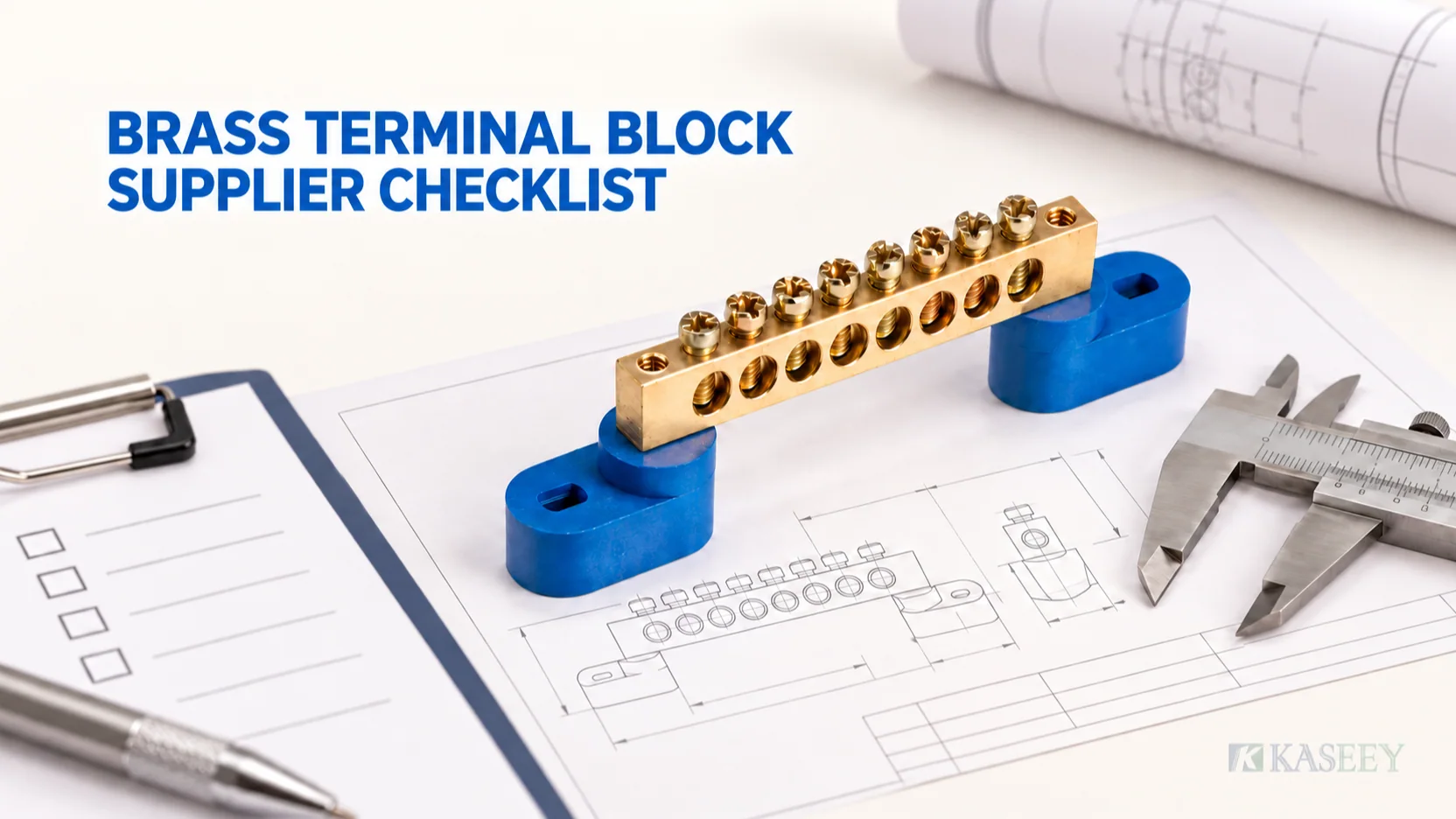
To qualify a brass terminal block supplier, define the exact component, verify its technical and material evidence, approve a representative sample and pilot lot, then agree how production batches will be identified and changes controlled. The useful outcome is an approval record that purchasing, engineering and incoming inspection can all use on the next order.
A quotation for “an eight-way brass terminal block” leaves too much open. Two parts can share the same way count while having different bar profiles, screw sizes, mounting dimensions or support arrangements. Supplier qualification should establish which configuration is approved and how the supplier will reproduce it.
Use the following workflow for OEM panel programs, private-label supply and repeat component purchasing. If the component itself has not yet been selected, start with the brass terminal block selection guide, then return here to build the supply approval record.
Create a qualification record for the exact component
Create one record for the proposed supplier and exact part or agreed product family. Assign an owner for technical approval and another for purchasing release. Record unresolved items as holds rather than treating an unanswered question as acceptance.
| Qualification gate | Evidence to request | What the buyer should be able to establish |
|---|---|---|
| Component definition | Order model, controlled drawing, revision and application | Which physical and electrical configuration is being assessed |
| Material and construction | Declared brass grade, screw and support specifications, agreed material records | What must remain consistent between sample and production |
| Sample approval | Identified samples, dimensional report and relevant verification evidence | Whether the proposed part meets the agreed requirements |
| Compliance scope | Applicable model documents and any required approval records | Whether the evidence covers the intended product and use |
| Pilot release | Agreed inspection results, packaging and lot identification | Whether the production route can reproduce the approved definition |
| Repeat supply | Traceability demonstration and change-notification agreement | How received goods can be connected to approval and production records |
This is a proposed buyer checklist. The records, tests and acceptance criteria should be agreed for the selected model and destination market; they are not a claim that every supplier includes every document in a standard order.
1. Freeze the order model and drawing revision
Give the supplier a specification that can be checked without relying on a product photograph. Include the number of connection positions, bar profile, conductor requirements, screw configuration, mounting dimensions, support arrangement, marking, accessories and intended electrical function. Identify the destination market and any documents required by your customer or panel approval process.
Distinguish a common distribution bar from a component intended to keep circuits isolated. Where several positions share one brass conductor, the panel design must define that common electrical connection. Colour alone does not establish a neutral or protective-earth function, and a similar-looking support does not prove the required mounting or bonding arrangement.
A published T002 example: the same way count is not the same part
The KASEEY T002 product page lists the following eight-way references. These are published dimensional examples for an enquiry, not interchangeable approved parts.
| Published order reference | Profile | L1 overall length | L2 installation dimension | Screw / published hole diameter |
|---|---|---|---|---|
| T002-0609/8 | 6 × 9 | 100 mm | 89.5 mm | M4 / 5.2 mm |
| T002-0812/8 | 8 × 12 | 103 mm | 90.5 mm | M5 / 6.0 mm |
The page also identifies blue and yellow variants with B and Y suffixes. Keep the selected variant in the approved order reference. Ask for the current controlled drawing before defining acceptance tolerances.
Neither the listed hole diameter nor the bar profile is a substitute for an approved conductor range. An M4 or M5 screw designation does not establish tightening torque. Request those requirements for the exact configuration rather than deriving them from dimensions.
2. Ask what proves the material and construction
“Brass” is a material description, not a complete purchasing specification. Ask the supplier to identify the proposed alloy or material designation and explain which record will support that declaration. Agree whether material evidence needs to be connected to the production lot or another traceable material reference.
The same review should cover the screws, finish and insulating or mounting supports where present. Ask which characteristics are controlled, how substitutions are reviewed and which acceptance limits will be used. A photograph cannot prove alloy chemistry, plating thickness, support material or long-term contact performance.
Useful questions include:
- What material designation will appear on the approved specification?
- Which material or incoming-inspection record can be supplied within the order scope?
- How are purchased screws and supports identified in the component definition?
- Which supplier or material changes require buyer review?
- How are nonconforming materials prevented from entering the released lot?
Require evidence relevant to your application. A long list of certificates with no connection to the proposed model or material lot is difficult to use in an approval decision.
3. Approve a representative sample against written criteria
Identify the samples by model, configuration and drawing revision. Ask whether they represent the intended production material, tooling and process. Record any difference between the samples and the proposed production route before approving them.
For dimensional review, compare measured values with the controlled drawing and its agreed tolerances. Relevant items may include overall length, fixing geometry, hole layout, screw position, support dimensions and fit within the intended panel. Record the measuring method and equipment identity so a later inspection can be repeated on the same basis.
For conductor connection and electrical suitability, use the exact model instructions and agreed verification plan. Confirm accepted conductor types and sizes, preparation, tightening requirements and any restrictions on multiple conductors. Decide which checks belong to the component supplier and which belong to the OEM’s completed assembly review.
Do not substitute a visual fit check for electrical verification. Likewise, tightening a screw by hand does not establish a torque limit or conductor retention performance. Use appropriately qualified personnel and the applicable test instructions where such checks are required.
Keep the approval decision with the evidence. A concise sample record should identify:
- The part number, configuration, drawing revision and sample identifiers.
- Measured characteristics and their acceptance limits.
- The documents or test evidence reviewed for the intended use.
- Deviations, corrective actions and items still on hold.
- The approval date, responsible person and retained reference sample.
4. Match compliance documents to the exact intended use
A company management certificate, a component approval and a finished-panel verification answer different questions. Assess them separately. ISO 9001 concerns the quality management system; it does not certify the electrical performance of an individual terminal block. The ISO/IAF guidance on expected outcomes explains this distinction.
Ask the supplier which product standard and edition its evidence addresses. For example, the public scope of IEC 60947-7-1:2025 covers terminal blocks for copper conductors with screw or screwless clamping units fixed to a support. IEC 60947-7-2:2009 addresses protective conductor terminal blocks with a defined connection to their fixing support. Those scopes help frame the question; they do not automatically establish which standard applies to every brass distribution-bar construction or prove a KASEEY model complies.
For a North American project requiring UL evidence, check the actual product category, manufacturer, model coverage, ratings and restrictions. Review any relevant Conditions of Acceptability. UL’s certification-data guidance for OEMs explains why certification alone is insufficient to establish end-use suitability; Component Recognition concerns incorporation into a larger end product.
Hold approval when a document belongs to another product family, does not identify the proposed configuration, or cannot support the intended application. Resolve the coverage with the supplier and your responsible engineer or approval authority. Do not transfer a busbar report to a brass terminal block because both products are sold by the same company.
5. Release a pilot lot and test the traceability chain
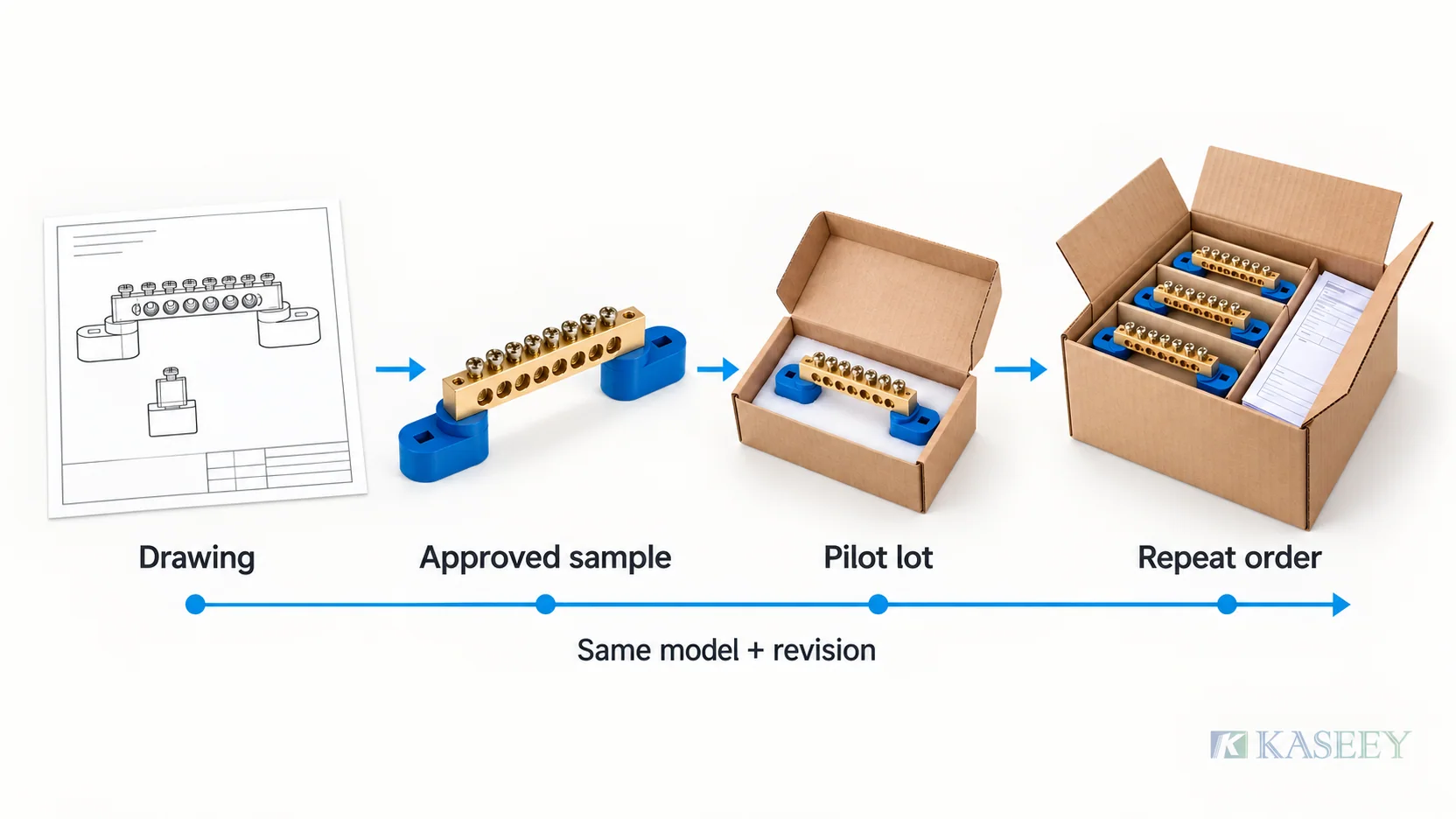
An approved sample establishes a reference. A pilot lot lets the buyer review how that reference is carried into a production order. Agree the pilot quantity, sampling method, inspection characteristics, acceptance criteria and required records before production begins. Avoid choosing a sampling rule after seeing the results.
Inspect the received parts against the same approved definition. Include model and colour identification, workmanship, agreed dimensional checks, packaging and any required connection or electrical evidence. Check that packing protects the exposed screws and brass surfaces and keeps order variants distinguishable.
Then perform a simple traceability exercise: choose one labelled package and ask the supplier to connect it to the order, production or inspection record, approved drawing revision and agreed material reference where applicable. The identifier might be a lot number, batch code or another agreed system. The essential requirement is that it produces a retrievable record.
A lot label that cannot be connected to supporting records is weak evidence. A photograph of a factory or test instrument does not demonstrate traceability for the shipment you received.
6. Agree change notification and nonconformance handling
Before repeat supply, define which changes require notice and buyer approval. Include changes to material, screw or support specification, finish, dimensions, tooling or process where they affect the approved component, and changes to marking or packaging that affect identification.
For each relevant change, agree who reviews it, which evidence is required and whether a new sample, pilot lot or application review is necessary. Keep the approved revision on the purchase order. A familiar sales description should not override the technical baseline.
Also define how rejected parts are identified, contained, investigated and resolved. Clarify who can authorize a deviation and whether repaired or replacement parts need another inspection. Purchasing should not silently accept a technical deviation to preserve a delivery date.
The final qualification decision can be approved, approved within a stated scope, or on hold. State the models and configurations covered, outstanding restrictions, next review trigger and people responsible. Qualification of one configuration should not be treated as automatic approval of every item in the supplier’s catalogue.
A ready-to-send supplier qualification request
Use this request with your drawing or selected product reference:
We are reviewing your brass terminal block for an OEM panel program. Please confirm the exact order model and drawing revision, proposed material and support specifications, conductor and tightening requirements, and the applicable model documents for our destination market. Please identify the sample and pilot approval route, available inspection records within the quotation scope, shipment-lot traceability, and your process for notifying us of changes. We will agree the acceptance criteria and release scope before a production order.
Attach your application, selected way count and configuration, drawings, quantity or forecast, market, marking and packaging requirements. Identify which documents are essential to approval and which are requested for commercial review.
For a KASEEY enquiry, begin with the brass terminal block product range and quote the selected model or provide your controlled drawing. The OEM/ODM process describes review, definition, sample approval and production-release stages whose scope is confirmed for the project. Send the requirement package through Contact Sales so the next model, document or sample decision can be identified.